Looking for common ground
For common ground is rarely found. It is made—and then made again.
The Work Before the Agreement
We speak constantly of common ground, as though it were a patch of earth waiting beneath the quarrel. But common ground is rarely found. It is made.
It is made slowly, and usually by people who did not begin with the intention of making it. They begin with a task. A school requires attention. A neighborhood requires organizing. A public meeting requires attendance. A campaign requires signatures, doors, calls, records, and the stubborn return to the same work after the excitement has passed.
The modern political imagination has become enamored of arrival. We want the movement, the victory, the announcement, the crowd, the election night, and the measurable result. We are less interested in the quiet season beforehand, when there is no crowd, no victory, and no particular evidence that anything is happening at all.
Yet it is in that season that public life is built.
A group does not become a community merely because its members possess a common opinion. A mailing list is not an organization. A room full of people is not a movement. A slogan, however handsome, cannot perform the labor of trust. Before people can act together, they must learn that one another will appear, listen, remember, carry responsibility, and return.
This is why local organizing remains one of the strongest and most durable ways to preserve democracy. Local life is where political ideas cease to be decorations and become obligations. A promise is no longer made to “the public,” that immense and convenient abstraction, but to a parent, a neighbor, a student, a shopkeeper, or the person who has been waiting three months for the city to repair the same dangerous corner.
The local is not necessarily nobler than the national. It is simply nearer. Nearness creates consequence. Consequence creates responsibility. Responsibility, practiced repeatedly, may become trust.
The facts are instructive. A 2025 survey by the Trust for Civic Life found that roughly 70 percent of respondents trusted local organizations, compared with only 25 percent who trusted national institutions. Three-quarters said their communities came together to solve problems, and one-third had worked with people of different political viewpoints or backgrounds to improve their communities. Pew Research likewise found that Americans viewed local government favorably by a margin of 61 percent to 22 percent over the federal government. These numbers do not prove that local life is free of foolishness. Anyone who has attended a municipal meeting knows better. They do suggest, however, that people retain more faith in institutions they can see, approach, question, and help repair.
The distinction is important. Democracy is not preserved merely by persuading people to hold the correct opinions. It is preserved by giving them repeated opportunities to exercise the habits upon which a free society depends: patience, participation, restraint, courage, compromise, and the willingness to do an unglamorous thing for a purpose larger than oneself.
Lincoln understood that the nation was not an idea floating above the people, but a structure continually built by them. In the midst of the Civil War, he spoke not of an easy triumph but of a “new birth of freedom.” The phrase carried within it an old truth: freedom is not inherited once and then secured forever. It must be renewed by labor. It must be given institutional form. It must be made real in the conduct of neighbors, voters, officials, teachers, workers, and citizens.
The same is true of every organization. The early work is almost comically unimpressive. Someone must make the list. Someone must call the people who did not answer yesterday. Someone must explain the plan for the fourth time. Someone must find a place to meet, write down what was decided, and discover that half the chairs are missing. Someone must stay after everyone else has gone.
No monument is raised to the person who correctly labeled the spreadsheet. Yet without that person, the monument may never be raised.
The temptation is to mistake growth for strength. But growth without a foundation merely enlarges the future collapse. An organization can gather attention quickly and still possess no capacity. It can attract followers without creating members, collect signatures without cultivating leaders, and produce enthusiasm without producing endurance.
Foundation-building appears slow because it is doing more than increasing numbers. It is forming relationships, distributing responsibility, and teaching people that their contribution matters. The work is not merely to find those who already agree. It is to develop the trust by which people who do not entirely agree can still act together.
That is the point at which political organization becomes something more universal than politics.
The person who volunteers to improve a school may care chiefly about discipline, while another cares chiefly about equity. One may speak in the language of order; another in the language of justice. They may disagree about causes, methods, and priorities. But if they remain long enough in the work, they may discover that both are trying, however imperfectly, to protect the future of children.
The agreement does not come first. The work reveals it.
Perhaps this is why arguments conducted at a distance so often become cruel. Distance permits us to reduce one another to positions. Shared effort restores dimension. It gives a face to the argument, a voice to the principle, and a human cost to every careless conclusion.
We do not need to abandon conviction in order to recover cooperation. Democracy does not require that citizens surrender their beliefs at the door. It requires only that they understand belief as a beginning, not an accomplishment.
Common values are not proven by the frequency with which we name them. They are proven by what we are willing to do for them, and by whether we are willing to do that work with others.
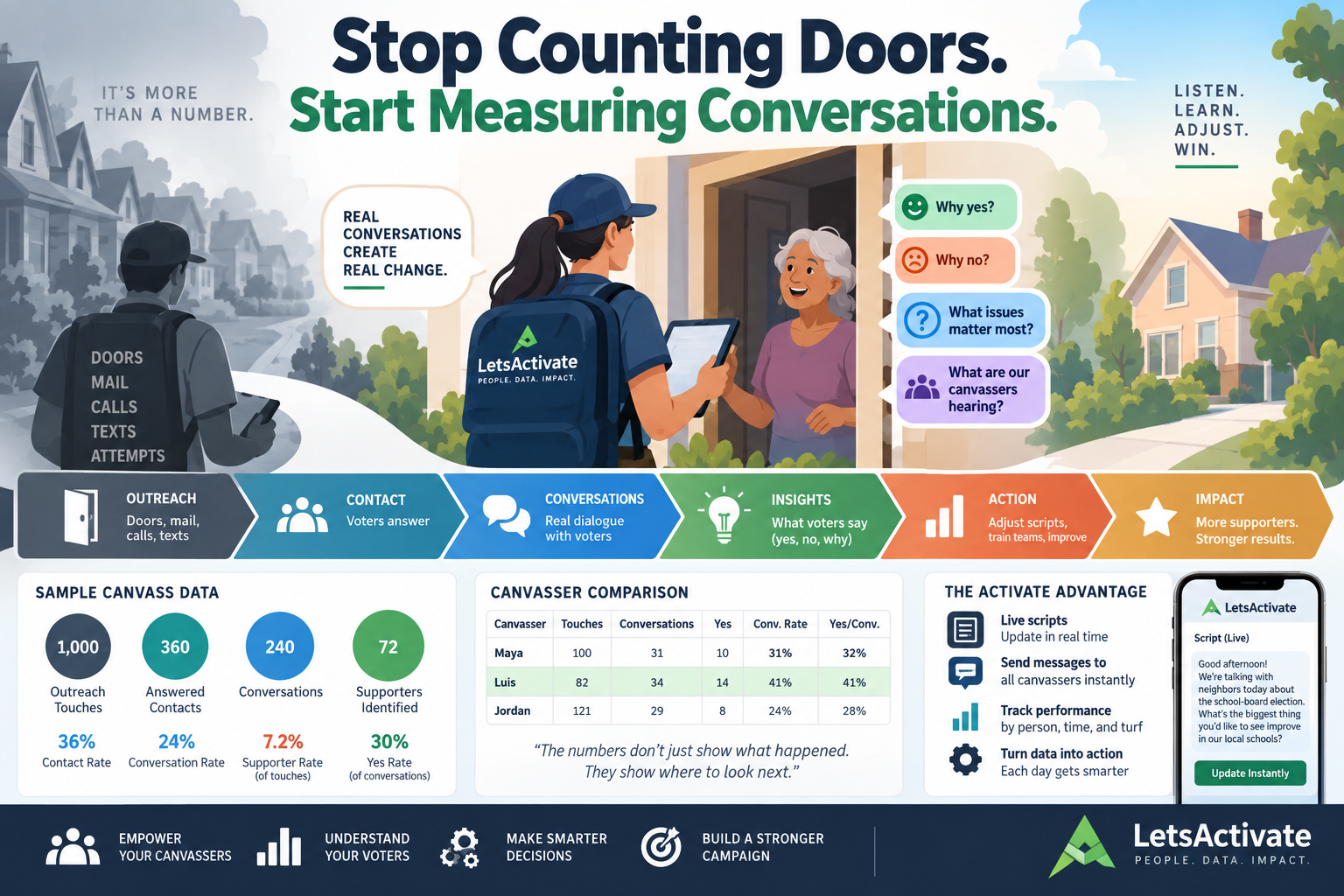
It is in these ideals that Activate (www.letsactivate.us) was born: not as a replacement for organizing, but as an instrument in its service. Its purpose is simple—to help people find one another, organize their effort, reach their neighbors, and see the work becoming possible. Technology cannot create commitment, courage, or trust. But it can help give those human qualities structure, direction, and reach.
Activate is now being shared because the work of democracy should not belong only to those who can afford expensive tools or already know how political organizations are built. If democracy is something people do, then the means of doing it should be placed in the hands of more people.
The common life is not built by people who think alike. It is built by people who discover, in the midst of necessary work, that their lives are answerable to one another. Agreement may be the language of common values, but effort is their first evidence.
And if the republic is to endure, it will not be saved by those who merely announce their love of democracy. It will be saved by those who gather the people, build the trust, keep the records, open the doors, repair the institutions, and return tomorrow to continue the work.
For common ground is rarely found. It is made—and then made again.