Walking is an Act of Confidence
Hey, Think about walking. Not metaphorically. Not yet. I mean actually walking.
Hey— Think about walking. Christi reminded me. I was taking a walk the other day and I realized I had a lot to say on the matter, so I asked him to remind me.
Not metaphorically. Not yet. I mean actually walking.
Stand up. Put one foot in front of the other.
What did you just do?
You allowed your body to move forward beyond the comfortable stability of standing. Your center of mass moved forward, your other leg swung ahead, and your foot created a new base of support.
In simpler language:
Fall. Catch.
Then:
Fall. Catch.
And again:
Fall. Catch.
We call it walking.
Biomechanics gives us a more precise description than simply calling walking “falling.” Human gait is often described through an inverted-pendulum model: our center of mass moves forward while our legs alternately support, propel and redirect the body. Walking isn’t an uncontrolled fall. It is a remarkably sophisticated process of creating forward instability and then managing it.
But I think there is something beautiful hidden inside the mechanics.
To go somewhere, you have to surrender the stability of where you are.
The Confidence to Take the Next Step
Most of us barely think about walking anymore.
We cross a room while thinking about something completely different. We carry coffee. Check our phones. Talk. Turn corners. Step around people. Our nervous systems perform an extraordinary sequence of calculations almost beneath our consciousness.
And yet confidence really can become part of walking.
Research in physical therapy, rehabilitation and gerontology has examined the relationship among gait, balance confidence, fear of falling and mobility. A systematic review and meta-analysis published in Gait & Posture, for example, found an association between fear of falling and greater gait variability in older adults (Ayoubi et al., 2015).
That does not mean that losing confidence simply causes someone to stumble. Human gait is influenced by neurological, muscular, sensory, orthopedic, environmental and psychological factors.
But the psychological component matters.
Researchers have therefore studied ideas such as balance confidence and fall-related self-efficacy: essentially, whether a person believes they can perform ordinary activities without falling. Fear can contribute to activity restriction; less activity can mean fewer opportunities to maintain strength, balance and mobility.
The mind and body are not strangers to each other.
We move partly because we believe movement is possible.
Before We Were Good at Walking, We Were Terrible at It
Now watch a child learning to walk.
This may be the most remarkable part.
Karen Adolph and her colleagues studied toddlers between 12 and 19 months old and found that these young walkers averaged roughly 2,368 steps and 17 falls per hour during observation (Adolph et al., 2012).
Seventeen falls.
In an hour.
And they kept going.
With experience, the children walked farther, accumulated more steps and became more proficient. Learning did not emerge from avoiding every failure. It emerged through an enormous amount of practice.
Imagine applying the standards of adulthood to that child.
You fell.
Maybe walking isn’t for you.
Perhaps somebody else is more qualified.
You should wait until you’re completely ready.
The child would never get anywhere.
Instead:
Fall.
Catch.
Fall.
Catch.
And sometimes:
Fall.
Get up.
Try again.
Psychology Has a Word for Some of This
Psychologist Albert Bandura called one important part of this self-efficacy: our belief in our capacity to organize and execute actions necessary to accomplish particular goals.
It is not simply positive thinking.
Bandura’s social cognitive theory describes human beings as agents capable of intentional action, forethought, self-regulation and reflection. What we believe about our capabilities can influence which challenges we attempt, how much effort we invest and whether we persist when things become difficult (Bandura, 2001).
That distinction matters.
Confidence cannot substitute for competence.
But without sufficient confidence to attempt something, we may never enter the process through which competence develops.
Edward Deci and Richard Ryan’s work on self-determination adds another useful framework. Self-determination theory emphasizes three psychological needs: autonomy, competence and relatedness.
Those words belong in a conversation about leadership.
Autonomy: I can choose to move.
Competence: I can learn how to move.
Relatedness: I do not have to move alone.
Leadership requires something from all three.
Leadership Means Moving Before Everything Is Certain
At some point in a career, nearly everyone encounters an opportunity that feels slightly beyond them.
A supervisory position.
A board seat.
A new profession.
A business.
A project nobody has attempted before.
A room where everybody seems more qualified than you.
A leadership position for which nobody has personally invited you to apply.
The safest response is to remain exactly where you are.
Both feet planted.
Perfectly balanced.
Perfectly stable.
And perfectly stationary.
Movement requires something different.
It requires enough confidence—not certainty—to transfer your weight forward.
Leadership does not mean knowing that the next step will work. It means believing there is sufficient reason to take it, accepting responsibility for what happens next and developing the ability to take another.
And Sometimes Leadership Means Public Service
There is another kind of step we sometimes forget to include when we talk about professional leadership:
public service.
Leadership doesn’t have to end at the boundary of your company, profession or organization.
Maybe you should serve on a local board.
Maybe you should volunteer for a commission.
Maybe there is a school board that needs someone with your experience.
Maybe your village, township or city council needs someone who understands what you understand.
Maybe you should run for local office.
That sentence can feel enormous:
Run for office.
But most public offices are not the presidency. Democracy is also built in school districts, municipalities, park boards, townships, villages, counties and neighborhoods. These are places where ordinary people make decisions affecting ordinary life.
And someone has to put their name forward.
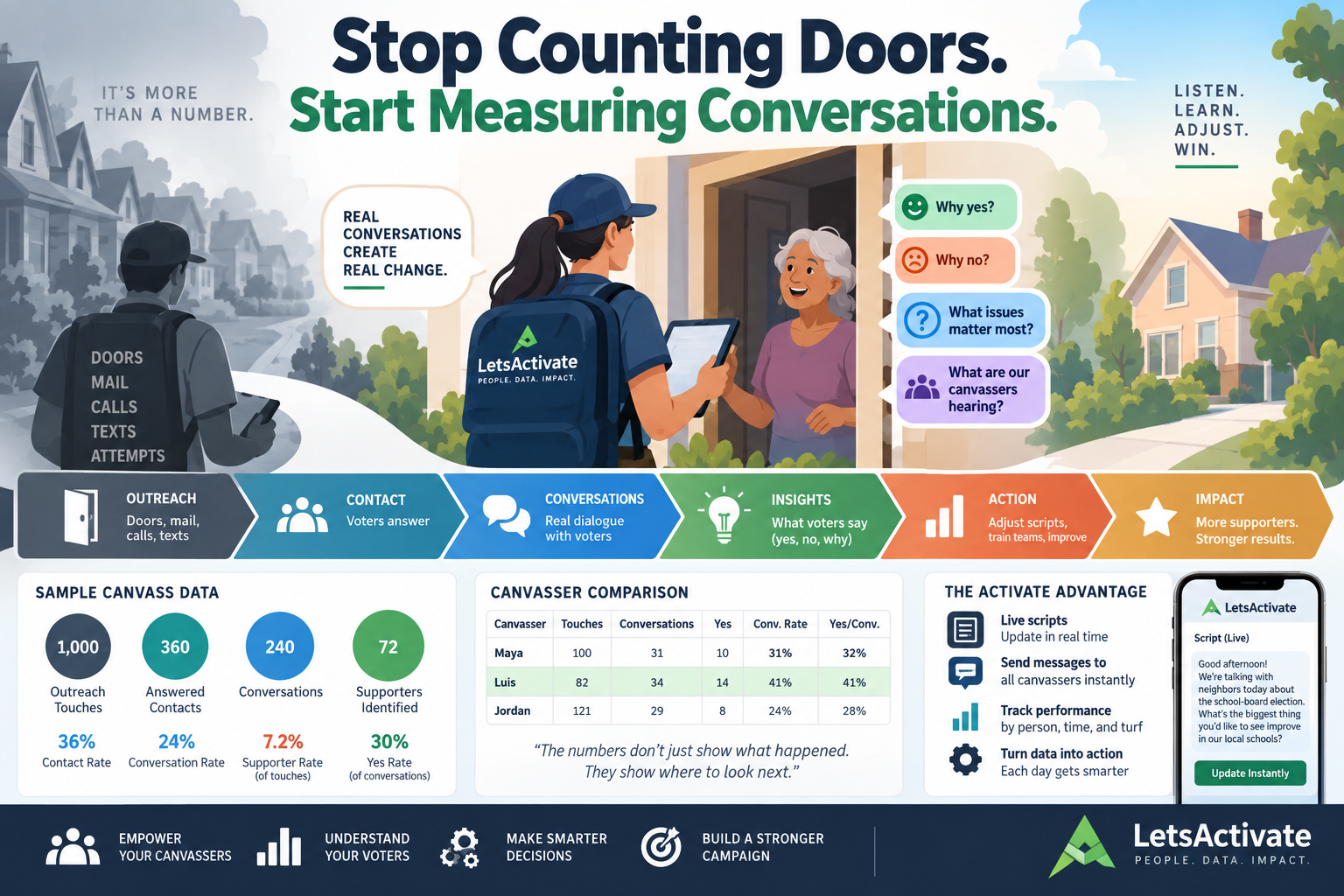
That is part of why we built Activate.
letsactivate.us is designed to give grassroots candidates and organizers practical campaign tools for the work that comes after somebody makes that first decision: I’m going to try.
Because a campaign eventually becomes very concrete.
Doors.
Calls.
Volunteers.
Voters.
Data.
Schedules.
Conversations.
People asking other people to believe in something enough to take their own next step.
Technology cannot supply courage. It cannot manufacture leadership. It cannot tell you that you deserve an office.
What it can do is make some of the mechanics of organizing easier once you decide to move.
And maybe the person reading this has spent twenty years developing expertise in education, construction, finance, technology, labor, healthcare, small business, public administration or something else your community desperately needs.
Maybe you have been waiting for someone to ask you.
Consider this the question:
Why not you?
Not because you are guaranteed to win.
Because leadership begins before the outcome is known.
Ask
There is a lesson I have learned professionally: many opportunities begin because somebody asks.
Ask for the responsibility.
Ask to lead the project.
Ask for the meeting.
Ask for the promotion.
Ask someone to teach you.
Ask someone to follow you.
Ask whether there is a seat at the table.
And sometimes, ask the public for the privilege of serving them.
Those who ask do not always get what they ask for. Institutions, economics, discrimination, timing, preparation, opportunity and luck are real. Confidence is not magic.
But there are opportunities we cannot receive because we never permitted ourselves to pursue them.
Sometimes the first qualification for leadership is possessing enough confidence to say:
I would like to try.
Then accepting the instability that follows.
From the Child to the Elder
At the beginning of life, walking is uncertain.
A child stands.
Wobbles.
Steps.
Falls.
Gets back up.
Years pass, and walking becomes so automatic that we stop appreciating what we are accomplishing.
Eventually, for many people, walking becomes deliberate again.
The stride may shorten. Balance may require greater attention. A railing that once seemed unnecessary becomes useful. Research on aging has shown why fear of falling, balance confidence and mobility deserve serious attention: they can affect activity and independence.
There is dignity at both ends of that journey.
The child says:
I haven’t learned this yet.
The elder says:
I know this movement, but now I must approach it differently.
And between them is the rest of us, walking around as though this astonishing act were nothing.
Fall.
Catch.
Fall.
Catch.
Forward.
Even When You Fall
Maybe that is what walking has been teaching us all along.
Self-confidence does not mean believing you will never fall.
That isn’t confidence.
That’s fantasy.
Confidence is knowing that falling does not settle the question of whether you can walk.
Leadership works much the same way.
There will be a bad meeting.
There will be a rejection.
There will be an idea that doesn’t work.
There will be a job you don’t get, an election you don’t win, a proposal somebody rejects or a moment when the people around you simply don’t see what you see.
There may even be a moment when you don’t believe in you.
But remember how you got across the room this morning.
You gave up the security of standing still.
You moved your weight forward.
You trusted the next foot to arrive.
And it did.
Then you did it again.
And again.
And again.
You don’t need enough confidence to know exactly where every step will lead.
You need enough confidence to take the next one.
And if you fall?
You are still there for yourself.
Even when you fall.
Even when you fall.
References
Adolph, K. E., Cole, W. G., Komati, M., Garciaguirre, J. S., Badaly, D., Lingeman, J. M., Chan, G. L. Y., & Sotsky, R. B. (2012). How do you learn to walk? Thousands of steps and dozens of falls per day. Psychological Science, 23(11), 1387–1394.
Ayoubi, F., Launay, C. P., Annweiler, C., & Beauchet, O. (2015). Fear of falling and gait variability in older adults: A systematic review and meta-analysis. Journal of the American Medical Directors Association, 16(1), 14–19.
Bandura, A. (2001). Social cognitive theory: An agentic perspective. Annual Review of Psychology, 52, 1–26.
Deci, E. L., & Ryan, R. M. (2008). Self-determination theory: A macrotheory of human motivation, development, and health. Canadian Psychology, 49(3), 182–185.