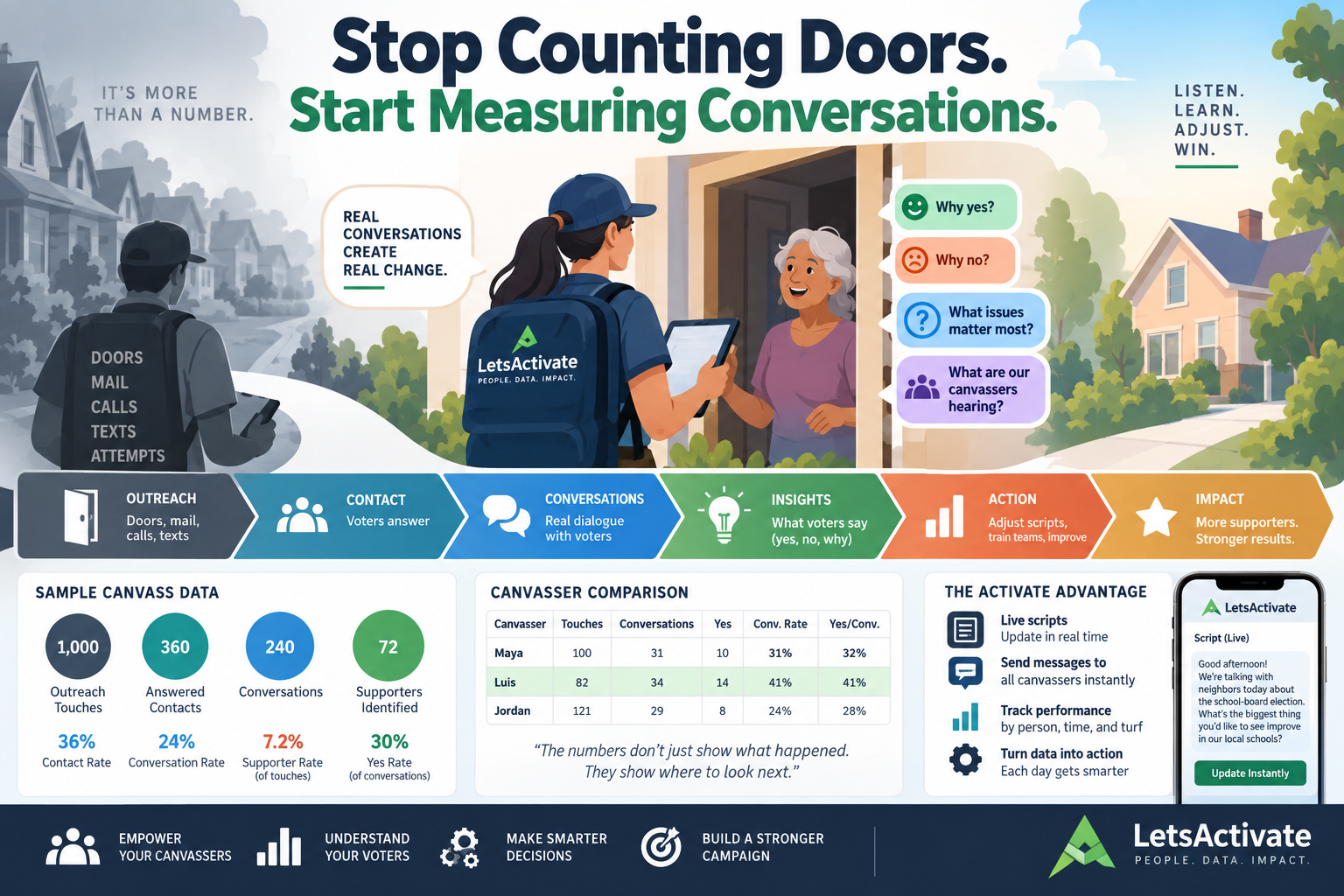
Stop Counting Doors. Start Measuring Conversations.
Campaigns love big numbers.
10,000 doors knocked.
40,000 pieces of mail delivered.
5,000 calls attempted.
Put those numbers on a whiteboard and they look impressive. Put them in a campaign email and they sound like momentum.
But here is the question I think campaigns should ask more often:
What happened when somebody actually answered?
Because knocking on a door is an activity.
Having a conversation is an opportunity.
And earning a new supporter is a result.
Those are three different things.
That distinction is the idea behind what we at Activate (www.letsactivate.us) call the Conversation Meter: count the real exchanges with voters, not merely the attempts to reach them.
The difference matters.
Research in political field organizing has repeatedly demonstrated the importance of actual voter contact. In a randomized experiment involving roughly 30,000 registered voters, Alan Gerber and Donald Green found that personal canvassing increased turnout substantially, while direct mail produced a smaller effect and telephone calls in that experiment produced no detectable effect. Later experiments across six cities likewise found face-to-face mobilization effective across a range of local elections.[1][2]
But persuasion is harder.
A major meta-analysis and series of field experiments published in the American Political Science Review found essentially zero average persuasive effect from campaign contact in general elections, with effects appearing under more limited circumstances.[3]
That finding should make campaign managers more curious, not less.
If persuasion is difficult, then simply knowing that your team knocked 4,000 doors tells you remarkably little about whether your campaign is getting better at it.
The Funnel Matters
Imagine Saturday’s canvass produces this:
1,000 outreach touches 360 answered contacts 240 actual conversations 72 supporters identified
Now we have something we can study.
The campaign’s contact rate is:
360 ÷ 1,000 = 36%
Its conversation rate is:
240 ÷ 1,000 = 24%
And if the campaign defines its operational persuasion metric as newly identified supporters divided by outreach touches, its observed supporter-identification rate is:
72 ÷ 1,000 = 7.2%
You might also want to know:
72 ÷ 240 = 30%
Thirty percent of completed conversations ended with the voter being recorded as a supporter.
I would be careful about calling that 30% a scientifically proven causal persuasion rate. Some of those people may already have supported the candidate before the canvasser arrived.
But as an operational campaign metric?
It is enormously useful.
Now compare Saturday with next Saturday.
Did the contact rate rise?
Did conversations rise?
Did identified support rise?
Did the ratio between conversations and Yes responses change?
That is how a field program begins learning instead of merely counting.
Then Ask Why
Suppose one canvasser attempts 100 doors and has 18 conversations.
Another attempts 72 doors and has 25 conversations.
Another attempts only 61 doors but identifies 11 supporters.
Who had the best shift?
The answer isn’t contained in the door count.
Maybe one canvasser is moving faster. Maybe another is better at getting people to stay at the door. Maybe one was assigned much denser turf. Maybe another got an apartment building where everybody answered.
Or maybe one canvasser discovered a better way to begin the conversation.
That is why context matters.
In Activate’s (www.letsactivate.us) Conversation Meter approach, a Yes or No represents an exchange in which someone answered and the campaign’s ask was actually raised. Not Home and Skip still record activity, but they don’t advance the Conversation Meter.
That distinction lets a manager separate effort from engagement.
And once you can do that, you can start asking better questions.
Listen to Your Canvassers
Your canvassers possess something your campaign manager sitting at headquarters does not:
dozens or hundreds of tiny samples of voter reaction.
Ask them.
What are people saying?
Where are they interrupting the script?
What question keeps coming up?
Why are voters saying no?
Why are voters saying yes?
What sentence makes someone lean against the doorway and continue talking?
What sentence makes the door begin to close?
Campaigns spend enormous amounts of money developing messages. Then they send volunteers into the field, where actual voters respond to those messages in real time.
That feedback is valuable data.
Don’t waste it.
Your Script Is Not Scripture
A canvassing script should be short enough to remember, natural enough to say, and flexible enough to become a conversation.
Something like:
“Hi, I’m Daniel, volunteering with the Smith campaign. We’re talking with neighbors today about the school-board election. What’s the biggest thing you’d like to see improve in our local schools?”
Notice what happens there.
I haven’t delivered a speech.
I’ve introduced myself, explained why I’m standing on the porch, established the election we’re talking about, and then asked a real question.
Now I have to listen.
Suppose the campaign discovers that voters overwhelmingly answer: class size.
The campaign can examine whether its existing message actually addresses what voters are bringing up.
Suppose canvassers report that the opening takes too long.
Shorten it.
Suppose voters don’t understand which office the candidate is running for.
Clarify it.
Suppose the script contains three paragraphs that practically nobody can remember.
That isn’t really a canvassing script anymore.
It is literature.
A Script Should Be Alive
This is one of the reasons we built Activate the way we did.
Put the campaign’s script directly into the canvassing system.
The canvasser can read it while working.
And when the campaign needs to change it, change it.
Not tomorrow.
Not after somebody prints another 75 walk packets.
Now.
Imagine it is 1:30 Saturday afternoon and the canvass ends at 2:00.
Maybe the script that began:
“Good morning…”
should now say:
“Good afternoon…”
That sounds trivial.
But good campaigns pay attention to little things because voters experience campaigns through little things.
Or perhaps the field director needs everybody back.
Send the field team a message:
“Finish the door you’re on, complete your current conversation, and come on back. Great work today.”
The field operation shouldn’t have to wait until everybody returns to headquarters before headquarters understands what happened in the field.
Analytics Should Create Questions
This is where the numbers become genuinely interesting.
Imagine three canvassers:
Canvasser Touches Conversations Yes Conversation Rate Yes/Conversation Maya 100 31 10 31% 32% Luis 82 34 14 41% 41% Jordan 121 29 8 24% 28%
The wrong conclusion is:
Luis is the best canvasser.
We don’t know that yet.
Maybe Luis had better turf.
Maybe Maya encountered more locked buildings.
Maybe Jordan worked at a worse time of day.
The numbers don’t eliminate the need for management.
They tell management where to look.
Talk to Luis. What is he doing?
Talk to Jordan. What is he hearing?
Compare their turf.
Compare their times.
Compare their scripts.
Compare Saturday with Sunday.
Then do it again next week.
Every Canvass Makes Tomorrow’s Analytics Better
This is the part of field organizing that fascinates me.
Day One gives you information.
Day Two gives you comparison.
Day Three begins giving you patterns.
After several weeks, you can begin asking whether contact rates differ by time, turf or shift; whether one opening consistently produces longer conversations; whether particular voter concerns keep appearing; and whether apparent differences between canvassers persist after accounting for where and when they worked.
The analytics do not become infallible merely because the dataset gets larger. Campaign data can contain selection effects, different turf, changing voter universes, inconsistent coding and many other sources of bias.
But disciplined measurement gives the campaign progressively more evidence with which to test its assumptions.
That’s much more useful than:
“We knocked another 1,000 doors.”
Great.
What happened?
The Most Important Number May Be the One Between the Numbers
Political campaigns understandably count production.
Doors.
Calls.
Texts.
Mail.
Volunteer shifts.
Those numbers matter. A campaign that doesn’t contact voters isn’t going to learn much from them.
But production is the beginning of the equation, not the end.
I want to know:
How many people answered?
How many conversations occurred?
How many supporters were identified?
What objections did we hear?
What arguments resonated?
Which script was being used?
Which turf were we in?
What time was it?
What changed after we adjusted?
And perhaps most importantly:
What did our canvassers learn today that should change what we do tomorrow?
That’s the philosophy behind the Conversation Meter and much of what we’re building into Activate (www.letsactivate.us).
A campaign shouldn’t have to wait until Election Day to learn whether its field program worked.
Measure it while there is still time to make it better.
Because a door knocked is an attempt.
A conversation is information.
And a campaign that listens—to its voters, its canvassers and its own data—has something far more useful than a large number on a whiteboard.
It has a field program that can learn.
⸻
References
[1] Alan S. Gerber & Donald P. Green, “The Effects of Canvassing, Telephone Calls, and Direct Mail on Voter Turnout: A Field Experiment,” American Political Science Review 94(3), 653–663 (2000). (ISPS)
[2] Donald P. Green, Alan S. Gerber & David W. Nickerson, “Getting Out the Vote in Local Elections: Results from Six Door-to-Door Experiments,” The Journal of Politics 65(4), 1083–1096 (2003). (ISPS)
[3] Joshua L. Kalla & David E. Broockman, “The Minimal Persuasive Effects of Campaign Contact in General Elections: Evidence from 49 Field Experiments,” American Political Science Review 112(1), 148–166 (2018). The study reports an average persuasive effect near zero in general-election field experiments while identifying narrower circumstances in which effects may emerge. (Cambridge University Press)
[4] Activate, “The Conversation Meter Is the Pace Number a Field Program Should Run On,” August 26, 2026. The framework distinguishes attempts from actual conversations and recommends using live response data for mid-shift field management. (Activate)